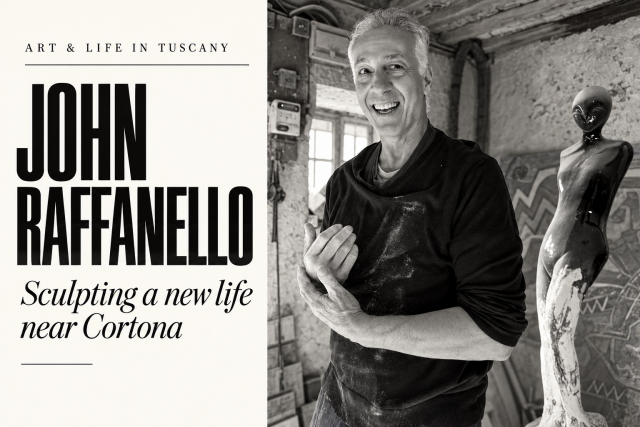
Classical inspiration, Italian roots and everyday connections have shaped the artist’s new life in Tuscany.
John Raffanello is an American sculptor with Italian roots who lives and works near Cortona, Tuscany. His creative practice includes sculpture, painting and Italian Renaissance-inspired wooden furniture, drawing on more than 37 years of experience.
In his home and studio, John explores the human figure through contemporary interpretations of classical forms. His story also offers a personal glimpse of life in Tuscany: finding a home, learning the language and becoming part of a local community.
About John Raffanello
John’s move to Italy began with his son, Joe.
After spending three years studying art in Florence, Joe wanted to build his future in Italy. John, who had spent many years raising him as a single father, decided to make the move with him.
Today, Joe lives in Ferrara with his own family, while John has established his home and studio near Cortona.
Finding the right house took three years. Once he found it, John began creating the workshop where he could continue his artistic practice and give his new life a creative centre.

John’s studio brings together sculptures, paintings and Renaissance-inspired wooden furniture. It is a working environment where materials, tools and pieces in progress form part of everyday life.
Having a workshop at home allows him to revisit ideas over time. A sculpture can be set aside and reconsidered months later; a piece near the doorway can prompt a new observation each time he passes.
Living in Italy has also brought John closer to the artistic traditions that have long interested him. Classical sculpture and historical furniture design provide starting points for work shaped by his own choices and experiments.
Classical Italian sculpture and the human figure are central to John’s work. Many of his pieces explore the female form, using altered proportions to give traditional subjects a contemporary expression.
In works such as Lady Nightshade, elongated arms, legs and thighs change the figure’s balance and character. These choices invite viewers to reconsider forms they may initially find familiar.
John hopes his sculptures encourage people to pause, look again and spend time with the work. His approach combines an appreciation of classical art with curiosity about how its visual language can evolve.

John’s sculptural practice involves physical work, close observation and patient refinement.
Dust and noise are part of the process. His hands, clothes and boots often carry traces of the workshop, reflecting the practical effort behind the finished pieces.
The time involved varies:
One statue stands beside the front door of his home. Passing it each day gives him another opportunity to notice a surface, a line or a detail he would like to adjust.
For John, completing a sculpture can be a gradual process. Looking remains part of making.

Alongside sculpture, John creates wooden furniture influenced by the Italian Renaissance and pursues painting.
These different practices reflect his longstanding interest in art and craftsmanship. They also reveal a broader creative life than sculpture alone can show.
His furniture connects that interest to objects made to be lived with and used, while painting offers another medium for expression. Together, these works help explain the range of activity within his studio near Cortona.

 Becoming Part of the Local Community
John’s art has helped him become a familiar presence in the area.
He recalls needing to visit the supermarket while still wearing his dusty work clothes and boots. His son questioned whether he should go inside dressed for the workshop.
John went anyway.
Curious looks soon became conversations. Those encounters helped him meet people, and he gradually became known locally as “the sculptor of the village”.
For John, settling in Tuscany has involved these small, repeated exchanges as much as the larger decisions about moving country and finding a home.
The local ferramenta, or hardware shop, has provided another setting for connection.
Although John knows the technical vocabulary of his craft in English, finding the right Italian word sometimes requires improvisation.
During one visit, he asked for biscotti, translating the American woodworking term “biscuits” directly into Italian. His request sounded as though he wanted something to eat.
Laughter followed before everyone worked out which item he needed.
The misunderstanding became a shared joke, and the shop became another place where John was recognised and welcomed.
John’s connection to Italy also grew through his family’s research into their ancestry.
While Joe was pursuing Italian citizenship, the family began exploring their Italian roots. According to John’s account, the research revealed connections to Puglia, Tuscany and the area around Castiglion Fiorentino.
Having already chosen to settle near Cortona, John found personal meaning in that discovery.
The area where he was building a new life also offered a connection to his family’s past, adding another dimension to his growing sense of belonging.
John Raffanello’s story brings together a working artist’s practice and the experience of making a home in Tuscany.
His sculptures express an ongoing interest in classical forms and contemporary ideas. His furniture and paintings reveal other aspects of that curiosity. The studio gives these pursuits a place to develop, while everyday encounters connect him to the community beyond it.
At home near Cortona, John continues to make, observe and refine.
And beside his front door, a sculpture still offers the possibility of one more adjustment.
Send us your posts, viewpoints
and/or personal experiences
CONTACT US NOW
OUR BLOG IS INTENDED AS A CENTRAL HUB FOR CORTONA LOVERS WORLD-WIDE, BRINGING YOU USEFUL INFORMATION, PROFILES OF THE MANY INTERESTING PEOPLE WHO LIVE & VISIT THE TOWN, UP-DATES ON LOCAL NEWS, SPECIAL STORIES & UPCOMING EVENTS
Have a story or an anecdote to recount? Someone interesting you’d like to profile? A place you’ve visited that you’d like to recommend? Whether it’s useful, funny or informative, why not share it on My Cortona blog and add your name to our list of regular contributors? We’d love to hear from you.

In a unique collaboration, Cortona International is able to offer its clients, a team of English-speaking estate agents & property managers who provide specialist knowledge in all aspects of buying, managing & selling property to a largely international clientele
PREVIEW

Price: €.750.000
Price: €.220.000

Price: €.380.000

